An inspiring collection of essays, in which Albert Einstein addresses the topics that fascinated him as a scientist, philosopher, and humanitarian. Divided by subject matter - âScience,â âConvictions and Beliefs,â âPublic Affairs,â etc. - these essays consider everything from the need for a âsupranationalâ governing body to control war in the atomic age, to freedom in research and education, to Jewish history and Zionism, to explanations of the physics and scientific thought that brought him world recognition.
Throughout, Einsteinâs clear, eloquent voice presents an idealistâs vision and relays complex theories to the layperson. Einsteinâs essays share his philosophical beliefs, scientific reasoning, and hopes for a brighter future, and show how one of the greatest minds of all time fully engaged with the changing world around him. This authorized Philosophical Library audiobook features never-before-seen documents from the Albert Einstein Archives at the Hebrew University of Jerusalem.
âEthical axioms are found and tested not very differently from the axioms of science. Truth is what stands the test of experience.â - Albert Einstein, âThe Law of Science and the Laws of Ethicsâ
Albert Einstein (1879â1955) was born in Germany and became an American citizen in 1940. A world-famous theoretical physicist, he as awarded the 1921 Nobel Prize for Physics and is renowned for his Theory of Relativity. In addition to his scientific work, Einstein was an influential humanist who spoke widely about politics, ethics, and social causes. After leaving Europe, Einstein taught at Princeton University. His theories were instrumental in shaping the atomic age.
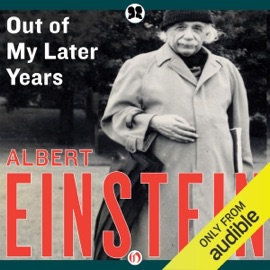
Out of My Later Years: The Scientist, Philosopher, and Man Portrayed Through His Own Words (Unabridged) - Albert Einstein
An inspiring collection of essays, in which Albert Einstein addresses the topics that fascinated him as a scientist, philosopher, and humanitarian. Divided by subject matter - âScience,â âConvictions and Beliefs,â âPublic Affairs,â etc. - these essays consider everything from the need for a âsupranationalâ governing body to control war in the atomic age, to freedom in research and education, to Jewish history and Zionism, to explanations of the physics and scientific thought that brought him world recognition.
Throughout, Einsteinâs clear, eloquent voice presents an idealistâs vision and relays complex theories to the layperson. Einsteinâs essays share his philosophical beliefs, scientific reasoning, and hopes for a brighter future, and show how one of the greatest minds of all time fully engaged with the changing world around him. This authorized Philosophical Library audiobook features never-before-seen documents from the Albert Einstein Archives at the Hebrew University of Jerusalem.
âEthical axioms are found and tested not very differently from the axioms of science. Truth is what stands the test of experience.â - Albert Einstein, âThe Law of Science and the Laws of Ethicsâ
Albert Einstein (1879â1955) was born in Germany and became an American citizen in 1940. A world-famous theoretical physicist, he as awarded the 1921 Nobel Prize for Physics and is renowned for his Theory of Relativity. In addition to his scientific work, Einstein was an influential humanist who spoke widely about politics, ethics, and social causes. After leaving Europe, Einstein taught at Princeton University. His theories were instrumental in shaping the atomic age.