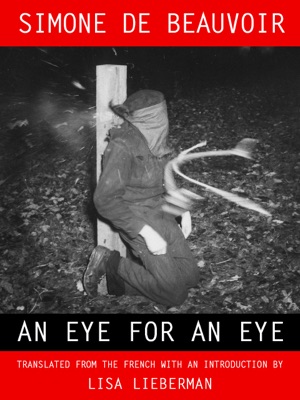
Where does vengeance end and justice begin? The question is no easier to resolve today than when Simone de Beauvoir wrote this compelling essay in the aftermath of World War II.
The immediate occasion for âAn Eye for an Eyeâ was the execution by firing squad of French collaborator Robert Brasillach, a prominent right-wing author who had edited a fascist newspaper during the Occupation. Beauvoir had been in the courtroom for Brasillachâs trial and admits that she was moved by the manâs dignity on the stand. Nevertheless she and Jean-Paul Sartre refused to sign the petition circulated by leading cultural figures of the day calling for his pardon.
In this essay, originally published in 1946, now translated from the French with an introduction by Lisa Lieberman. she explains why.
---
Simone de Beauvoir (1908â1986), studied philosophy at the Sorbonne and taught for a number of years before leaving academic life to write. She became a leading French public intellectual, political activist, feminist theorist, and social theorist, her most influential book being The Second Sex, a classic study of what it means to be a woman. Beauvoir did not consider herself a philosopher, but her significant contributions to existentialism have solidified her legacy in that field. She also wrote novels, essays, biographies, an autobiography in several volumes, and monographs on philosophy, politics, and social issues.
Where does vengeance end and justice begin? The question is no easier to resolve today than when Simone de Beauvoir wrote this compelling essay in the aftermath of World War II.
The immediate occasion for âAn Eye for an Eyeâ was the execution by firing squad of French collaborator Robert Brasillach, a prominent right-wing author who had edited a fascist newspaper during the Occupation. Beauvoir had been in the courtroom for Brasillachâs trial and admits that she was moved by the manâs dignity on the stand. Nevertheless she and Jean-Paul Sartre refused to sign the petition circulated by leading cultural figures of the day calling for his pardon.
In this essay, originally published in 1946, now translated from the French with an introduction by Lisa Lieberman. she explains why.
---
Simone de Beauvoir (1908â1986), studied philosophy at the Sorbonne and taught for a number of years before leaving academic life to write. She became a leading French public intellectual, political activist, feminist theorist, and social theorist, her most influential book being The Second Sex, a classic study of what it means to be a woman. Beauvoir did not consider herself a philosopher, but her significant contributions to existentialism have solidified her legacy in that field. She also wrote novels, essays, biographies, an autobiography in several volumes, and monographs on philosophy, politics, and social issues.